
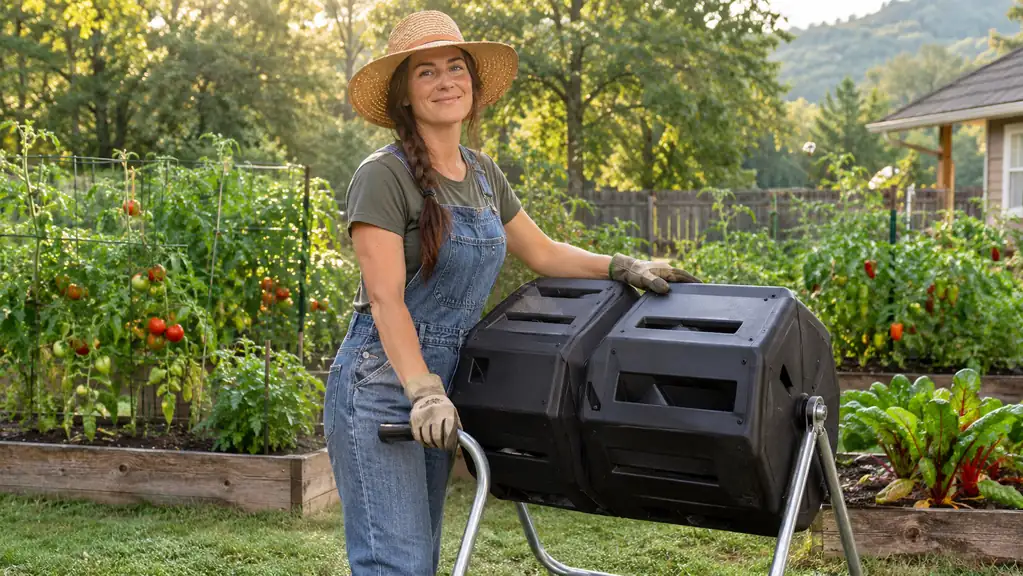
Every gardener I know has a compost pile that takes too long. Mine did. For years I kept an open pile behind the garage, turned it with a fork, and waited. And waited. The center stayed cold, the critters got in, and by the time anything looked like compost, my back had already filed a complaint. Then I bought the VIVOSUN dual chamber tumbling composter, and for the last two years I have not waited on compost. I have scheduled it.
A tumbler will not fix a pile that is too dry, too wet, or too full of the wrong stuff. But if you feed it the way it wants to be fed, a dual chamber tumbler can turn kitchen scraps and yard waste into usable compost in about three to six weeks in warm weather. That is not a promise from the manufacturer. That is what happens when the pile gets air, moisture, and the right mix of greens and browns. Here is the method I use, step by step.
Stop Turning a Pile That Never Finishes
A dual chamber tumbler keeps one batch cooking while you fill the other. That is the whole trick, and the VIVOSUN 43 gallon model makes it easy on your back.
Amazon Check Today's Price on Amazon →Step 1: Set Up the Tumbler Where You Will Actually Use It
The VIVOSUN tumbler holds 43 gallons and weighs 21.7 pounds empty. It is not a heavy machine, but it is an awkward one to carry once you start filling it, so put it where you want it before you add a single scrap. I keep mine near the kitchen door, about ten steps from the back porch. That short walk is the difference between tossing scraps into the tumbler and letting them sit in a bowl on the counter while I tell myself I will deal with them later.
You want a spot with level ground, because the frame needs to sit flat when you spin it. I learned this the hard way. The first spring I had the tumbler, I set it on a patch of ground that sloped just a little, and the whole drum listed to one side when it was half full. Every spin felt like wrestling a stubborn mule. Level the base before you fill it, even if that means shoving a paver under one corner.
You also want the tumbler in partial shade if you can manage it. Full sun dries the pile out fast in an Arkansas summer, and a dry pile is a slow pile. My tumbler gets morning sun and afternoon shade, and I rarely have to add water except in the hottest weeks. In July, when the temperature stays above ninety for days, I check the moisture every time I spin it.
One more thing. Read the assembly instructions all the way through before you start. The panels go together in a specific order, and the deep fins on the inside of the drum are what actually turn the material when you rotate it. I put mine together in about an hour with Dale holding the frame steady. The included garden gloves are waterproof, and they are not a gimmick. I use them every time I open the door.
Step 2: Chop Everything Before It Goes In
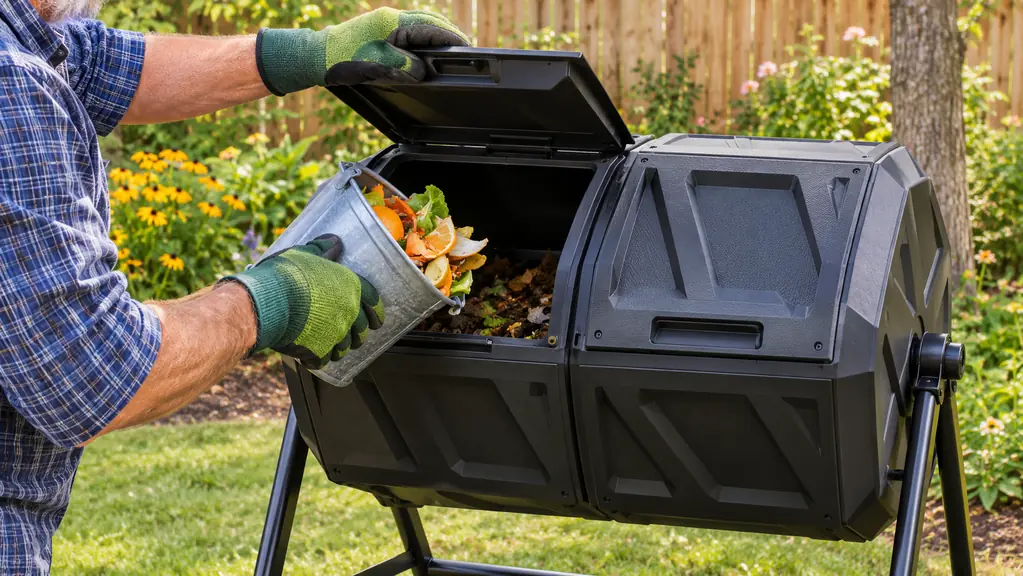
The single fastest way to speed up compost is to make the pieces small. A whole cabbage core takes months. A cabbage core chopped into inch pieces takes weeks. A blender would be faster still, but I am not blending my kitchen scraps, and you do not need to either. A sharp knife and a few extra seconds at the cutting board are enough. On canning days, when I am putting up tomatoes and green beans, I chop the peels and ends while I am already at the counter.
For yard waste, I run leaves and small twigs through the mower once before they go in. If I am adding spent plants from the garden, I cut them into six inch pieces with pruning shears. The goal is surface area. More surface area means the microbes can get to more of the material at once, which means the pile heats up faster and breaks down faster. A pile of whole tomato vines will mat together and go slimy. The same vines cut into pieces stay loose and airy.
This is also the step where I remove anything that does not belong. No meat, no dairy, no oil, no diseased plants. The tumbler is not a garbage can. It is a digestion system, and it works best when it only has to digest things that rot quickly and safely. I keep a little bucket by the sink for scraps, and I empty it into the tumbler once a day, usually right after breakfast.
Step 3: Feed the Chambers in the Right Order
The dual chamber design is the reason I chose this tumbler over a single drum. One chamber cooks while the other one fills. I fill the left chamber over the course of about a week, adding scraps and browns in roughly equal layers. When it is full, I stop adding to it, give it a good spin, and start filling the right chamber. By the time the right chamber is full, the left chamber is usually close to done. Last fall, the left chamber finished in exactly five weeks while the right one was still filling.
The mix matters more than the order. Greens are your kitchen scraps, fresh grass clippings, and spent plants. Browns are dry leaves, shredded paper, cardboard, and straw. I aim for about two parts browns to one part greens by volume. That is not a precise science. If the pile smells like ammonia, I add more browns. If it is dry and dusty, I add more greens. The pile tells you what it needs.
Keep a small container of shredded paper or dry leaves next to the tumbler. Every time I add kitchen scraps, I toss in a handful of browns on top. That simple habit keeps the pile from getting soggy, keeps the fruit flies down, and means I am never scrambling for dry material when I need it. I use the shredded paper from the office recycling bin, and the pile does not seem to mind the ink.
Step 4: Turn It Every Two to Three Days
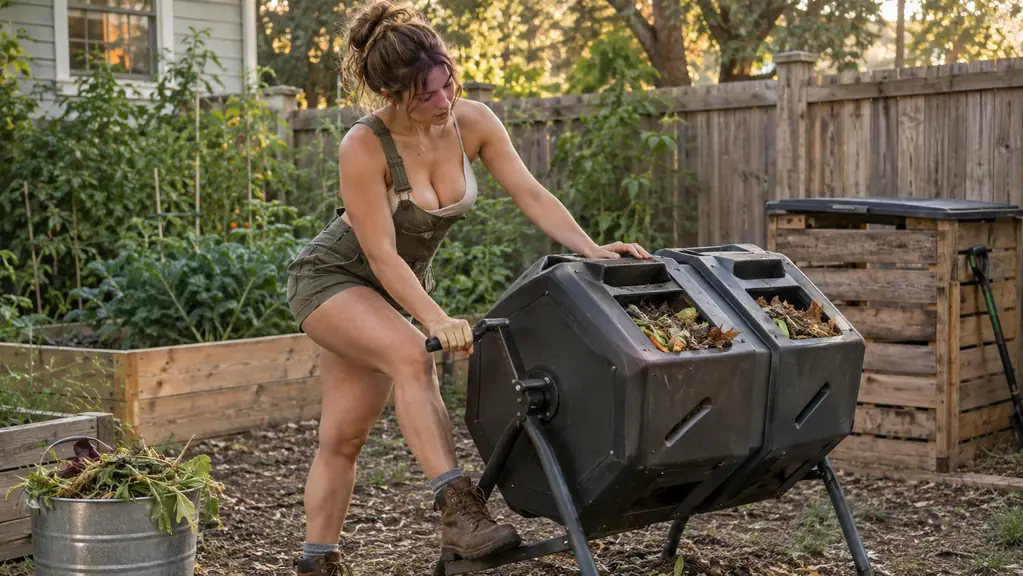
The VIVOSUN tumbler rotates a full 360 degrees, which means you never have to dig into the pile or mix it by hand. I give each chamber about ten full rotations every two to three days. That is it. Ten spins, three times a week, and the deep fins inside the drum do the work of lifting and dropping the material so air gets through the whole pile. On a good week, I spin the left chamber on Monday and Thursday and the right chamber on Tuesday and Saturday.
Turning is what feeds oxygen to the microbes, and oxygen is what keeps the pile hot instead of smelly. A pile that sits undisturbed goes anaerobic, which is the polite word for rotten. A pile that gets turned regularly stays aerobic, which is the polite word for compost. The difference between the two is the difference between a tumbler that works and a tumbler that just sits there.
If you are not sure whether to turn it, turn it. The only time I skip a turn is when the pile is frozen solid in January, and even then I give it a spin as soon as it thaws. The motion is easy on my hands, which matters to me. I have mild arthritis, and the old method of stabbing a fork into a pile and heaving it over was exactly the kind of motion my joints do not appreciate anymore. With the tumbler, I can turn both chambers without bending over.
Step 5: Know When It Is Done
Finished compost is dark, crumbly, and smells like earth. It does not look like the stuff you put in. You should not be able to recognize the banana peel or the shredded paper. If you still can, it is not done. Give it another week and turn it again. The first time I emptied a chamber, I was surprised at how little it looked like the garden soil I was used to. It looked better, and it smelled like a forest floor after rain.
In warm weather, my VIVOSUN tumbler produces finished compost in three to six weeks per chamber. In cool weather, it takes longer, sometimes eight to ten weeks. That is normal. The microbes slow down when the temperature drops, just like the rest of us. I do not fight the seasons. I fill the chambers in the fall, let them cook slowly through the winter, and screen the finished compost in early spring.
When a chamber is done, I empty it into a wheelbarrow and screen it through a half inch hardware cloth. The coarse bits that do not fall through go back into the chamber with the next batch as a starter. That is a free inoculation. The finished compost goes onto the raised beds, into transplant holes, or into my seed starting mix. Nothing is wasted.
What Else Helps
A tumbler is a tool, not a magic box. The things that made my compost faster had nothing to do with the equipment and everything to do with how I fed it. Keep a countertop bucket for kitchen scraps so you only make one trip a day. Keep the browns next to the tumbler so the layers stay balanced. If the pile is dry, add water a little at a time and spin it. If it is soggy, add more browns and spin it. The spin is your only real job.
I also stopped being precious about the finished product. Compost does not need to be perfect to be useful. Half-finished compost works fine as a mulch on the vegetable beds in fall, where it finishes breaking down over the winter. The worms and the soil life do the rest. My own compost goes into the soil, and I also use Wiggle Worm castings in my seed starting mix and transplant holes. Good soil is a system, and compost is only one part of it.
Ten spins, three times a week, and the deep fins inside the drum do the work. That is the whole method, and it is the reason my compost finishes in weeks instead of months.
What I Would Tell a Friend Starting Out
If you are new to composting, do not try to make it perfect. Start with a small bucket of kitchen scraps and a bag of dry leaves. Add them to the tumbler in layers, spin it every few days, and let the pile teach you. You will make mistakes. I made plenty. I added too many greens and the pile smelled like a barn. I let it dry out and the pile sat there for a month. Both times, the fix was simple: more browns, more water, more turning.
The VIVOSUN dual chamber tumbler is not the cheapest composter on the market, and it is not the biggest. But it is the one that made composting work for my body and my schedule. The two chambers mean I always have one batch finishing while I fill the other. The rotating design means I never dig or mix by hand. And the 43 gallon capacity means I am not emptying it every week. For a gardener with a bad back and a busy life, that is exactly the right combination.
Let the Tumbler Do the Turning
Two chambers, ten spins, three times a week. That is the whole method, and the VIVOSUN 43 gallon tumbler makes it easy. Check today's price and see if it fits your garden.
Amazon Check Today's Price on Amazon →