
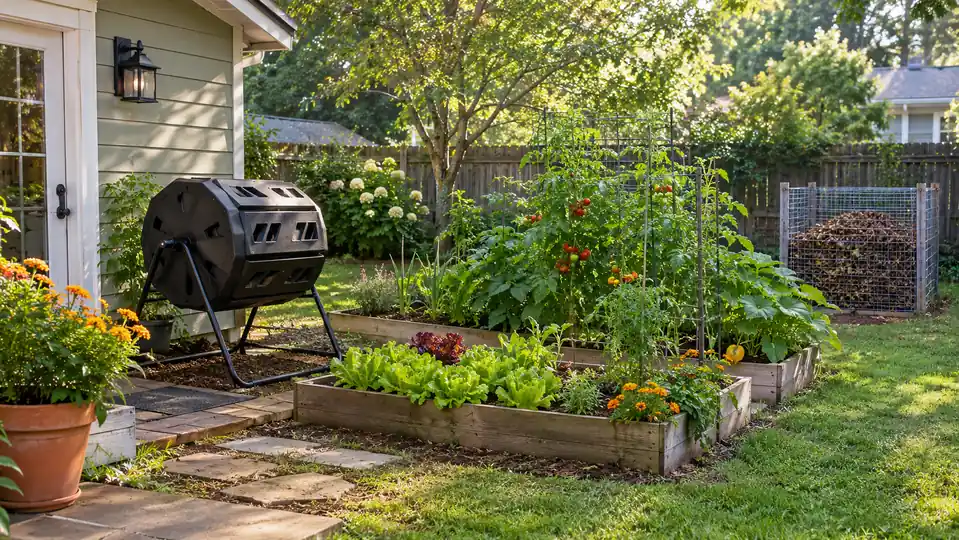
I spent years composting the slow way. My open pile sat at the back of the garden, and every time I turned it with a fork, my lower back reminded me why I kept putting it off. It cooked eventually, but it took the better part of a year, and the raccoons treated it like a buffet. Two years ago I switched to a VIVOSUN tumbling composter, 43 gallons, and it changed how I think about compost. But here is the question I get from neighbors and from readers every spring: does a tumbler actually make better compost than a plain stationary bin, or is it just easier on the back? I have now run both, side by side in my memory if not in my yard, and I am going to give you the honest answer, including the places where the old way wins.
Short answer: for a backyard vegetable garden the size of mine, the VIVOSUN makes better compost faster, and it is far kinder to a 61-year-old back. The stationary bin still has a place, especially if you have a big garden and a mountain of leaves every fall. I kept one going for years, and I will tell you exactly where it wins, because it does win some rounds. But if you want finished compost you can actually use on your tomatoes, peppers, and greens, the tumbler earns its spot near my kitchen door. The rest of this article is the why, the how, and the honest tradeoffs of both.
| VIVOSUN Tumbler | Stationary Compost Bin | |
|---|---|---|
| Turning effort | Six rotations a couple of times a week, no digging or forking | Forking and turning by hand, which is hard on the back |
| Speed to finished compost | About six weeks in warm weather for small batches | Often six months to a year for a cold pile |
| Total volume | 43 gallons split across two chambers | A three-bin setup holds several times more |
| Cold weather | Above-ground composter can freeze solid in a hard winter | Sits on the soil, stays warmer, keeps working |
| Critter resistance | Galvanized steel body with a door that closes | Open top invites raccoons unless you add a lid |
| Worm and soil life | Raised off the ground, few worms find their way in | Ground contact lets worms and microbes move in |
| Moisture control | Door keeps rain out, you add water as needed | Open to weather, drowns in wet weeks, dries out in dry ones |
| Best for | Small to mid-size gardens and backs that need a break | Big gardens, lots of leaves, and gardeners who can wait |
Where VIVOSUN Wins
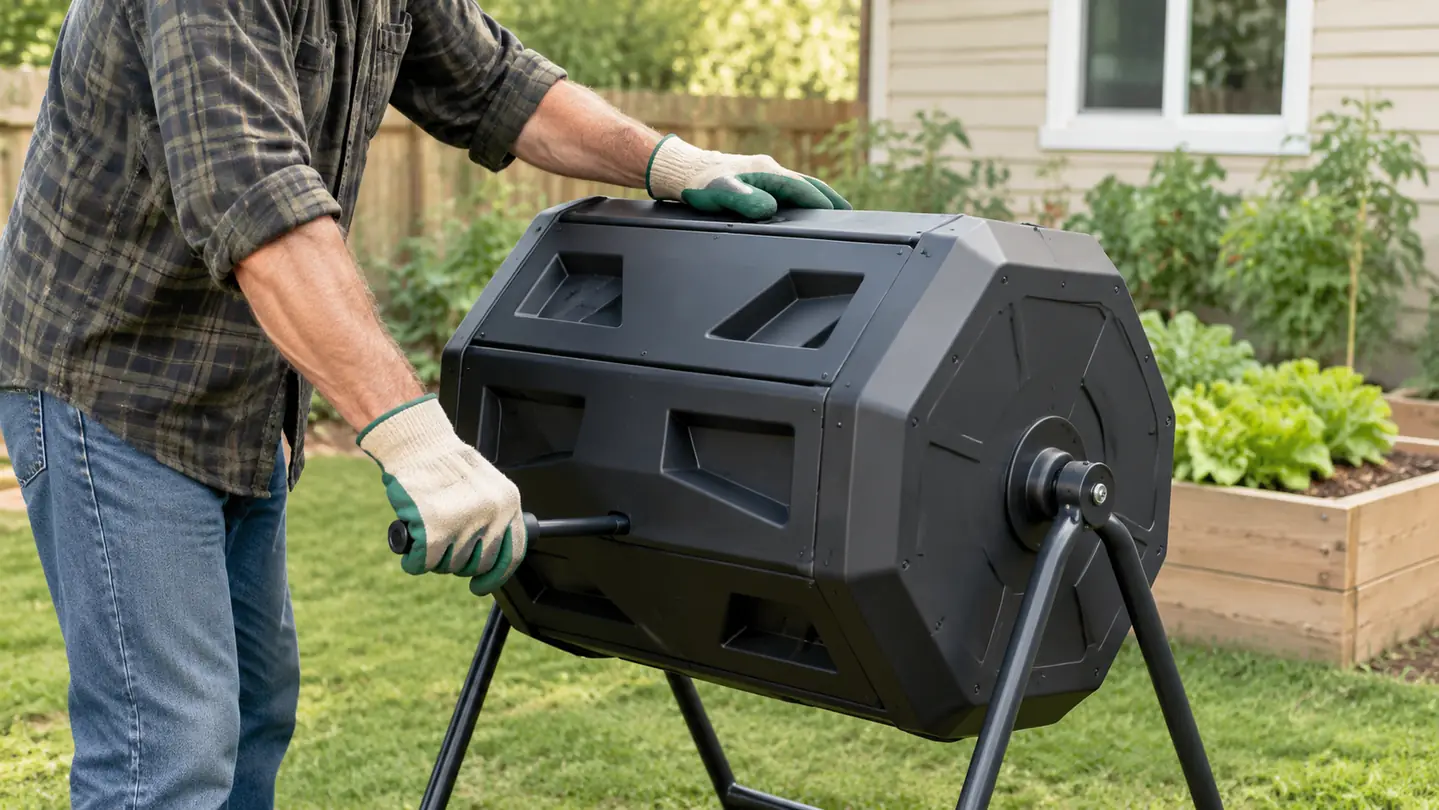
The biggest difference is speed, and speed comes down to air. Compost needs oxygen, and a stationary pile gets it only when you turn it by hand, which is why mine sat half-done for months at a time. The VIVOSUN's rotating design does the turning for you. Six spins a couple of times a week, and the deep fins on the eight panels lift and drop the material so air reaches the middle of the load. I fill one chamber while the other cooks, and in warm weather I have had usable compost in about six weeks. In the cooler months it takes closer to twelve, which is still about half the time my old pile needed.
The second win is critter resistance, and this matters more than people admit. My old open pile drew raccoons, and once the neighborhood dogs found it, they rolled in it. The VIVOSUN is a galvanized steel body with a door that closes. In two years, nothing has gotten into it. It also keeps the rain off, which matters here in the Arkansas Ozarks, where we get sudden downpours. A pile that drowns turns slimy and sour. The tumbler holds moisture better because I control it, and the garden gloves that came with it mean I do not have to touch the material to know whether it needs water.
And then there is the back factor. I have mild arthritis in my hands and a lower back that complains after a long day of digging. Forking a soggy pile of kitchen scraps and leaves is exactly the kind of work I cannot do as well at 61 as I could at 40. Twisting a tumbler a few times is nothing. That alone would justify the switch for me, and I suspect it will for you too. Gardening should not hurt, and compost should not be the chore that makes you quit gardening.
Six spins a couple of times a week beats an afternoon of forking, and the compost comes out twice as fast.
Where a Stationary Bin Wins
Now let me be fair, because I do not want you to buy a tumbler and discover it is the wrong tool for your yard. A stationary bin wins on sheer volume. The VIVOSUN holds 43 gallons split across two chambers, which is plenty for kitchen scraps and garden trimmings from a half-acre lot. But if you have a big vegetable garden, a couple of mature trees, and a lawn that produces bags of grass clippings, you will fill a 43-gallon tumbler in a week. A three-bin stationary setup holds several times more, and you can let it sit for a year without worrying about space. If your main goal is to get rid of yard waste rather than to make soil for a small garden, volume matters more than speed.
A stationary bin also wins in winter. The VIVOSUN sits up off the ground, and in a hard freeze the contents can freeze solid. It thaws and keeps working, but it stops cooking until spring. A bin that sits directly on the soil stays warmer because the earth holds heat, and worms and soil microbes move right in through the bottom. That ground contact is a real advantage. It is also why a stationary bin is better at building a living soil food web, while a tumbler is better at producing clean, finished compost fast. If you garden for the soil life as much as for the harvest, that difference matters.
There is also the cost question, and I will not pretend it does not matter. A stationary bin can be built for very little from pallets or hardware cloth, while a tumbler is a manufactured product with moving parts. If money is the main constraint and you have more time than back strength, a stationary bin is the honest choice. I built my first one from scrap wood and it worked. It just worked slowly. And if you are handy, a stationary bin is a weekend project you can finish with scrap lumber and a staple gun.
Want finished compost this season, not next year?
The VIVOSUN 43-gallon tumbler turns for you, keeps out the critters, and cooks a batch in about six weeks in warm weather. Check today's price on Amazon and see if it fits your garden.
Amazon Check Today's Price on Amazon →Who Should Buy Which
Buy the VIVOSUN if you want compost you can actually use this season, if your garden is small to mid-size, if raccoons and rodents are a problem, or if your back and hands need a break from forking. That is me, exactly. It sits near the kitchen door, one chamber cooking while I fill the other, and the compost goes onto my raised beds and my tomatoes, peppers, squash, and greens. I also use it to top-dress the kale and lettuce in fall. It is not a decoration. It is the workhorse of my soil-building routine.
Choose a stationary bin if you have a large garden, a steady supply of leaves and yard waste, and the patience to wait a year. Choose it if you want the worms and soil life to do the work, or if you would rather spend very little on equipment and build something yourself. There is no shame in the slow way. It made good compost for me for years. It just made it slowly, and it cost me more in back pain than I want to admit. The right choice depends on your garden, your waste, and your body, not on which method sounds more impressive.
How I Compared Them
To be honest, this is not a laboratory test. It is two years of using the VIVOSUN next to a decade of memory of open-pile composting. I kept notes the first season: what went in, when I turned it, and when it finally looked like compost. The tumbler gave me dark, crumbly material in about six weeks in summer and about twelve in the cooler months. The open pile took the better part of a year and never broke down evenly. The edges stayed dry and the middle stayed soggy, and the whole thing was a home for pill bugs and grubs. I am not saying a stationary bin cannot make good compost. I am saying mine did not, because I could not turn it often enough.
I should also say what I feed each one. The tumbler gets kitchen scraps, coffee grounds, eggshells, and chopped leaves, all in roughly the right ratio. The stationary bin, when I had it, got everything, including big stalks and branches, and that is another reason it was slow. Big woody material needs a long time no matter what holds it. If you want fast compost, you have to feed the pile the way you feed a cookstove: small pieces, the right mix, and regular stirring. I keep a small bucket on the counter for scraps, and emptying it into the tumbler takes ten seconds. That is the kind of small convenience that keeps a habit alive.
What I Put In and What I Leave Out
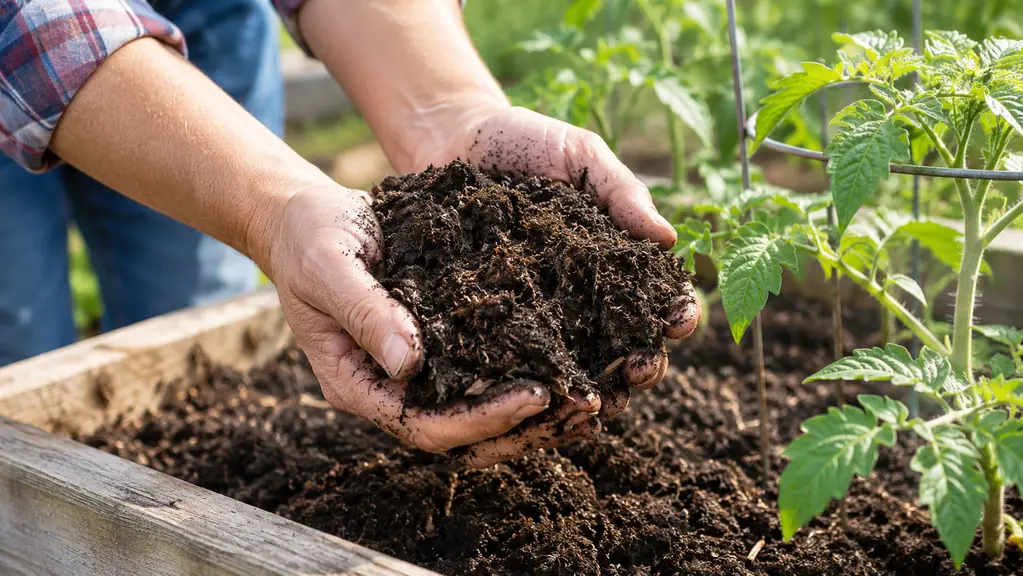
The tumbler likes a balanced diet. I add vegetable scraps, coffee grounds, eggshells, and chopped leaves, and I keep the ratio roughly half greens and half browns. When the load looks too wet, I add more leaves or a handful of shredded cardboard. When it looks dry, I add a little water. The fins do the mixing, but they cannot fix a load that is all one thing. A drum full of grass clippings will turn into a green, slimy mess no matter how often you spin it.
I leave out meat, bones, and oily food, the same things I left out of the old pile. I also leave out weeds that have gone to seed, because a tumbler does not get hot enough to reliably kill seeds, and I do not want to spread that problem onto my raised beds. Big woody stalks go to the edge of the property to break down on their own. Small pieces are the key. The smaller the pieces go in, the faster they come out as compost.
A Few Honest Notes on the VIVOSUN
No product is perfect, and the VIVOSUN has tradeoffs. The first is size. At 26.25 inches long and 23.6 inches wide, it is compact, which I like near the kitchen door, but you will not process a fall's worth of leaves in it. The second is the door. It closes well and has never popped open on me, but you do have to be deliberate about closing it when a chamber is full. The third is that a tumbler does not like long, stringy material. Grass clippings tangle around the fins, so I chop them or layer them with leaves. None of these are dealbreakers. They are just the truth about how the tool behaves.
The other note is about weight and weather. The unit itself is 21.7 pounds, light enough for me to move into place by myself, and the galvanized steel has held up through two Ozark summers and two winters. Two years in, it still turns smoothly and the fins still catch the material the way they did on day one. I cannot tell you how it will look after ten years, but I can tell you it has not given me a single reason to regret the purchase.
How the Two-Chamber Design Works
The thing I did not understand until I owned one is why two chambers matter. With a single bin, you either keep adding and never get finished compost, or you stop adding, wait, and have nowhere to put new scraps. The VIVOSUN solves that with twin chambers. I fill one side over a couple of weeks, and when it is full, I stop adding to it and start filling the other side. By the time the second side is full, the first side is usually done. It is a continuous cycle, and there is always a batch on the way.
The rotating design does the heavy work. Instead of digging into a pile with a fork, I give the composter six rotations a couple of times a week. The deep fins on the eight panels lift the material and drop it, which mixes air into the load the way turning does, but without the strain. I keep the door closed, which holds in heat and moisture, and I add a little water if the material looks dry. That is the whole routine. It takes about two minutes, twice a week, and it has become as automatic as watering the tomatoes.
The Bottom Line
So which makes better compost? For my money, the VIVOSUN tumbler does, because finished compost you actually use is better than a pile you keep meaning to turn. It is faster, cleaner, and easier on the body, and the two-chamber design means there is always a batch on the way. But the stationary bin is not a bad tool. It is a different tool for a different scale. Match the tool to your garden, your waste, and your back, and you will make good compost either way. That is the whole truth, and it is the same advice I would give you at my kitchen table.
The compost you actually use beats the pile you keep meaning to turn.
After two years, the VIVOSUN is still the first thing I check on my way to the garden. See today's price on Amazon and decide for yourself.
Amazon Check Today's Price on Amazon →